Shopify vs. WooCommerce for Wellness Brands : The Tech Stack Comparison
Both Shopify and WooCommerce power millions of online stores. But for wellness creators launching supplement, skincare, or functional food brands, the right choice depends on your technical confidence, compliance needs, and growth timeline. Here's the honest comparison.

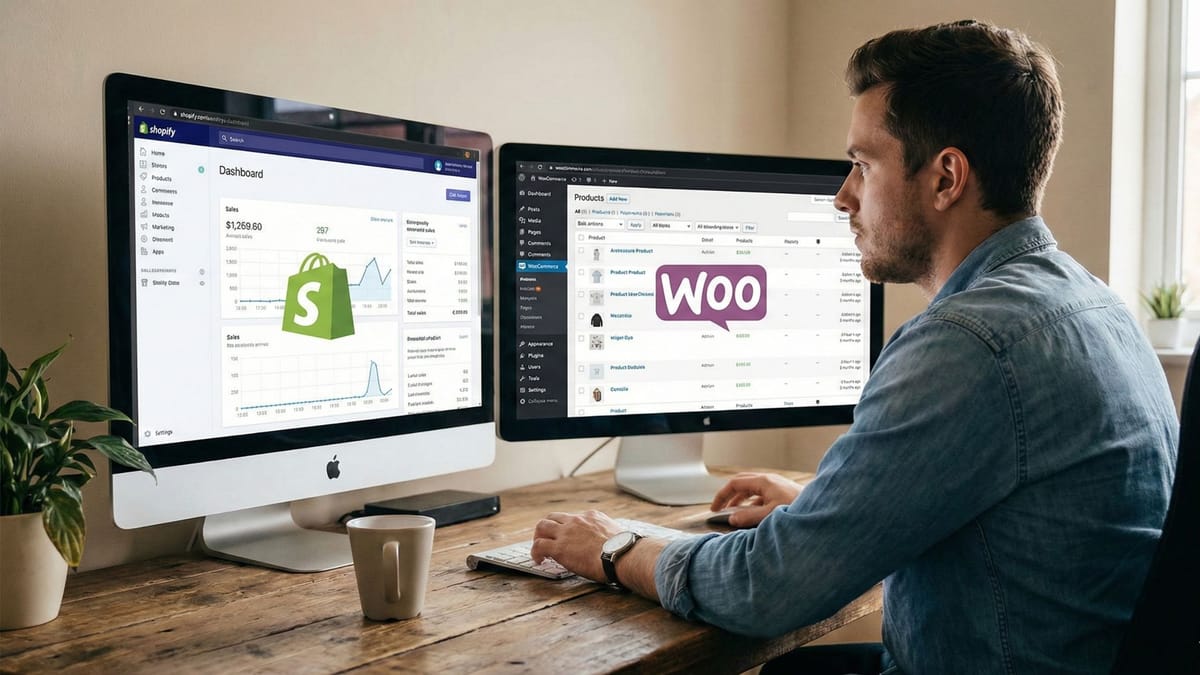
The Quick Answer
Shopify vs WooCommerce for wellness brands comes down to one question: do you want to build a store or manage a server?
Shopify is a fully hosted, all-in-one ecommerce platform where hosting, security, and performance are handled for you — ideal for wellness creators who want to focus on brand building, not backend management.
WooCommerce is a free, open-source WordPress plugin that gives you full control over every element of your store — but requires self-hosted infrastructure, plugin management, and ongoing technical maintenance. For most creator-led wellness brands launching from scratch — especially those using dropshipping partners like Supliful — Shopify delivers faster time-to-revenue with lower technical overhead.
WooCommerce is the stronger choice for brands with dedicated development teams, complex customisation needs, or deep content-led SEO strategies already running on WordPress.
Shopify vs WooCommerce for Wellness Brands: The Tech Stack Comparison That Actually Matters
Why This Comparison Is Different for Wellness Creators
Every "Shopify vs WooCommerce" article on the internet covers the same ground: pricing plans, theme libraries, plugin counts. Most of them are written for generic ecommerce — someone selling t-shirts, phone cases, or handmade candles.
Wellness is not generic ecommerce.
If you're launching a supplement brand, a skincare line, a functional tea business, or a digital wellness product — your ecommerce platform has to handle things most stores never think about. Regulatory compliance for supplement claims. Subscription billing for monthly replenishment products. Dropshipping integration with wellness-specific suppliers like Supliful. Trust-first design that communicates clinical credibility before a customer reads a single word.
The platform you choose isn't just a tech decision. It's a business infrastructure decision that affects your launch timeline, your operating costs, your compliance posture, and your ability to scale from ₹0 to ₹50 lakhs ($60,000+) in your first year.
This comparison is built specifically for wellness creators and founders. Every point is evaluated through the lens of what a wellness brand actually needs — not what a generic comparison chart shows.
The Numbers Behind Both Platforms in 2026
Before diving into the wellness-specific comparison, let's establish the scale of both platforms — because scale directly affects ecosystem quality, app availability, and long-term platform stability.
Shopify currently powers approximately 4.8 to 5.5 million active stores globally, with merchants processing over $292 billion in gross merchandise volume in 2024 alone. The platform reported $8.88 billion in annual revenue in 2024, growing at over 25% year-over-year. Among the top 1 million ecommerce websites by traffic, Shopify holds roughly 28.8% market share.
WooCommerce, the open-source WordPress plugin, powers between 4.3 and 4.6 million active stores depending on the tracking methodology used. It holds between 20% and 33% of the global ecommerce market share by store count — the range depends on whether you count only active checkout-enabled stores or all sites with WooCommerce installed. However, WooCommerce's estimated collective gross merchandise volume sits at $30–35 billion annually — roughly one-tenth of Shopify's transaction volume, spread across a comparable number of stores.
The takeaway: both platforms are massive, mature, and well-supported. But Shopify merchants generate significantly higher average revenue per store. For a wellness creator whose goal is building a real revenue-generating brand — not just putting up a website — that revenue-per-merchant gap is worth paying attention to.
What Each Platform Actually Is (And Isn't)
Understanding what you're choosing between requires understanding the fundamental architecture of each platform — because the way they're built determines what your daily experience as a brand owner looks like.
Shopify is a fully hosted, subscription-based ecommerce platform. You pay a monthly fee ($39–$399/month for standard plans, or $2,300+/month for Shopify Plus), and in exchange, Shopify handles your hosting, server security, SSL certificates, software updates, performance optimisation, and PCI compliance. You log in, set up your store, add products, and start selling. There is no server to manage, no security patches to apply, and no plugins to conflict with each other.
WooCommerce is a free, open-source ecommerce plugin that runs on WordPress. The plugin itself costs nothing. But to run a WooCommerce store, you need to separately purchase web hosting ($15–$100+/month), a domain, an SSL certificate, a WordPress theme, and various plugins for functionality that Shopify includes out of the box — things like payment processing, email marketing integration, subscription billing, and SEO optimisation. You are responsible for your own server uptime, security, updates, backups, and performance.
Neither platform is inherently "better." They represent two fundamentally different philosophies. Shopify says: we handle the technology, you handle the business. WooCommerce says: you handle everything, and in return, you control everything.
For wellness creators specifically, the question becomes: where should your time go in the first 12 months of building a brand?
The Real Cost Comparison — Beyond the Sticker Price
The most common misconception in this comparison is that WooCommerce is "free" and Shopify is "expensive." The truth is more nuanced — and for wellness brands, the total cost picture often favours Shopify at the launch stage.
Here's what each platform actually costs to run a functional wellness brand store:
Shopify — Monthly Cost Breakdown
- Platform subscription (Basic plan): $39/month (~₹3,250)
- Transaction fees (using Shopify Payments): 2.9% + 30¢ per transaction (waived platform fee)
- Transaction fees (using third-party gateway like Razorpay): 2.0% additional platform fee on Basic
- Theme: Free (Dawn, Sense, Craft) or $150–$380 one-time for premium
- Essential apps (reviews, upsell, email): $0–$80/month
- Domain: $14/year (~₹1,200)
Estimated monthly operating cost (pre-revenue): $39–$120/month (~₹3,250–₹10,000)
Woocommerce — Monthly Cost Breakdown
- WordPress hosting (quality managed hosting): $25–$100/month (~₹2,100–₹8,300)
- Domain: $14/year (~₹1,200)
- SSL certificate: Often included with hosting, otherwise $50–$100/year
- Premium theme: $50–$200 one-time
- Essential plugins (payment gateway, SEO, subscriptions, security, caching, backup): $30–$200/month
- Payment gateway fees (WooPayments/Razorpay/Stripe): 2.9% + 30¢ per transaction (comparable to Shopify)
- Developer maintenance (updates, plugin conflicts, security patches): $50–$200/month or significant personal time
Estimated monthly operating cost (pre-revenue): $105–$500/month (~₹8,700–₹41,500)
The critical insight: WooCommerce's "free" core is offset by the cumulative cost of hosting, plugins, maintenance, and developer time. For a wellness creator launching their first product brand, Shopify's predictable, bundled pricing typically delivers lower total cost of ownership in the first 12–18 months — with significantly less time spent on technical management.
Speed to Launch: Why 30 Days Matters for Wellness Brands
A wellness brand's launch window directly affects its revenue trajectory. Every week spent debugging plugin conflicts, configuring servers, or troubleshooting checkout is a week of zero revenue — and for a creator-led brand, that's a week where audience attention could be fading.
On Shopify, a complete wellness brand store — with product pages, checkout, payment processing, subscription support, and basic marketing automation — can be live in 7–14 days with focused execution. The platform requires no technical setup beyond configuring your store settings, choosing a theme, and adding products.
On WooCommerce, the same store typically requires 3–6 weeks. The additional time is consumed by hosting configuration, WordPress installation, theme customisation, plugin installation and compatibility testing, payment gateway integration, security hardening, and performance optimisation. Each of these steps is individually manageable — but collectively, they add significant time before your first product is available for purchase.
For a Brand Sewa client following the 30-day launch roadmap — where Week 1 covers business setup, Week 2 handles brand identity, Week 3 builds the store, and Week 4 activates marketing — Shopify's architecture allows the store build phase to stay within a single week. WooCommerce would consume the entire store-build week and potentially spill into the marketing activation phase.
Wellness-Specific Feature Comparison: Where It Gets Real
Here's where the generic comparison articles fall short. Wellness brands have specific functional requirements that most ecommerce stores don't. Let's evaluate both platforms against these requirements.
Subscription Billing
Wellness products — supplements, teas, skincare — are naturally recurring purchases. Monthly subscription revenue is the backbone of profitable wellness brands. Probiotics alone are one of the highest subscription-conversion categories in the supplement industry.
Shopify: Native subscription APIs with mature third-party apps like Recharge, Loop, and Bold Subscriptions. Setup is straightforward, integrates with checkout natively, and supports subscription management from the customer account page. Most subscription apps charge $49–$99/month plus a small per-transaction fee.
WooCommerce: WooCommerce Subscriptions is the primary plugin, priced at $239/year. It's powerful and flexible, but requires careful configuration and can conflict with other plugins. Third-party alternatives exist but are less mature than Shopify's ecosystem.
Verdict for wellness brands: Shopify's subscription ecosystem is more reliable and better supported for a store owner who isn't a developer.
Dropshipping Integration (Supliful, Exoteas)
Creator-led wellness brands using the private-label dropshipping model — which Brand Sewa's Wellness Brand Professional track is built around — need seamless supplier integration. No inventory holding, automated order routing, and real-time sync.
Shopify: Supliful has a dedicated Shopify app that integrates directly with your store. Product import, order forwarding, and fulfilment tracking are automated. This is not a workaround — it's a first-class integration built specifically for Shopify merchants.
WooCommerce: Supliful does not offer a native WooCommerce plugin. Integration requires either custom API development, a third-party connector (like Zapier), or manual order management. This adds cost, complexity, and a point of failure in your fulfilment chain.
Verdict for wellness brands: If you're using Supliful for private-label wellness products, Shopify is the only frictionless option.
Compliance and Trust Infrastructure
Wellness products — particularly supplements and skincare — carry regulatory requirements around ingredient disclosure, allergen listing, claim language, and disclaimer placement. Your store needs to support these cleanly.
Shopify: Product description fields, metafields for structured compliance data, and theme customisation allow you to build compliant product pages with ingredient transparency, allergen warnings, and disclaimer placement without developer intervention. Trust badges, review widgets, and social proof apps integrate natively.
WooCommerce: All of the same compliance information can be displayed, but typically requires custom fields via plugins like ACF (Advanced Custom Fields) or custom theme modifications. More flexible in theory, but more work in practice.
Verdict for wellness brands: Both can achieve compliance-ready product pages. Shopify gets there faster with less technical work. WooCommerce offers more granular control for brands with specific layout requirements and dedicated development support.
Payment Flexibility (India + Global)
Indian wellness creators selling domestically need UPI, net banking, and EMI support. Those selling internationally need USD/GBP/EUR checkout with Stripe or PayPal.
Shopify: Integrates natively with Razorpay, PayU, and Cashfree for the Indian market — supporting UPI, all major cards, net banking, and EMI. For international sales, Shopify Payments (powered by Stripe) handles multi-currency checkout. Shopify Markets enables multi-currency, multi-language storefronts from a single admin.
WooCommerce: Supports the same payment gateways through plugins — WooPayments (Stripe-based), Razorpay for WooCommerce, PayU plugin. However, each integration requires separate plugin installation, configuration, and compatibility verification. Multi-currency requires an additional plugin like WPML or Currency Switcher.
Verdict for wellness brands: Both platforms support Indian and international payment methods. Shopify's bundled approach is faster to configure and less prone to plugin conflicts. WooCommerce's plugin approach offers more gateway flexibility for unusual payment requirements.
Seo and Content Marketing
For wellness brands building organic traffic through educational content — the exact strategy Brand Sewa recommends — SEO capability matters significantly.
Shopify: Handles technical SEO basics well — clean URLs, auto-generated sitemaps, SSL, fast page loads via global CDN, and mobile responsiveness out of the box. However, Shopify's native blogging engine is limited. It lacks the editorial depth, content categorisation, and on-page SEO flexibility that serious content marketing requires. Most brands supplement Shopify's blog with an external content platform.
WooCommerce: Runs on WordPress — the most powerful content management system on the internet. WordPress is built for content. Plugins like Yoast SEO and Rank Math provide granular on-page optimisation, schema markup, content analysis, and internal linking recommendations that Shopify simply cannot match. If your growth strategy depends heavily on organic content — pillar pages, cluster posts, long-form guides — WordPress/WooCommerce has a structural advantage.
Verdict for wellness brands: WooCommerce wins on SEO and content marketing capability. Shopify wins on ecommerce-specific performance. The ideal architecture for a content-driven wellness brand may be Shopify for the store + a separate content platform (like Ghost or WordPress blog) for organic traffic — which is exactly the strategy outlined in Brand Sewa's customer acquisition framework.
Performance and Security
Shopify: Fully managed infrastructure with 99.99% uptime, global CDN, automatic SSL, PCI DSS Level 1 compliance, and DDoS protection. Page load times are typically under 2 seconds without any optimisation effort.
WooCommerce: Performance depends entirely on your hosting provider, theme quality, and number of active plugins. A well-optimised WooCommerce store can match Shopify's speed — but "well-optimised" requires ongoing technical attention. Security is your responsibility: regular WordPress core updates, plugin updates, malware scanning, and firewall configuration. A single outdated plugin can expose your entire store.
Verdict for wellness brands: Shopify eliminates the entire security and performance management burden. For a wellness creator whose primary skill is content creation and community building — not server administration — this is a significant operational advantage.
Side-by-Side Comparison Table: Shopify vs WooCommerce for Wellness Brands
| Category | Shopify | WooCommerce |
|---|---|---|
| Monthly cost (realistic) | ₹3,250–₹10,000 ($39–$120) | ₹8,700–₹41,500 ($105–$500) |
| Time to launch | 7–14 days | 3–6 weeks |
| Technical skill required | None | Moderate to high |
| Hosting & security | Fully managed | Self-managed |
| Subscription billing | Native API + mature apps | Plugin-based, requires configuration |
| Supliful integration | Native Shopify app | No native plugin — API or manual |
| Payment gateways (India) | Razorpay, PayU, Cashfree built-in | Plugin-based (same gateways available) |
| Multi-currency | Shopify Markets (built-in) | Requires additional plugin |
| SEO & content marketing | Basic — limited blog engine | Excellent — WordPress CMS advantage |
| Customisation depth | Moderate (Liquid templating) | Unlimited (open-source PHP) |
| App ecosystem | 13,000+ vetted apps | 59,000+ WordPress plugins (quality varies) |
| AI features (native) | Shopify Magic (descriptions, email, segmentation) | Third-party plugins ($30–$150/month extra) |
| Ongoing maintenance | Minimal — platform-managed | Significant — self-managed updates, backups, security |
| Best for | Creator-led brands, fast launch, dropshipping model | Developer-supported brands, complex customisation, content-first strategy |
When WooCommerce Is the Right Choice for a Wellness Brand
This isn't a one-sided recommendation. WooCommerce is genuinely the better platform in specific scenarios — and those scenarios are worth acknowledging honestly.
Choose WooCommerce if your wellness brand already has an established WordPress website with significant organic traffic and domain authority. Migrating that SEO equity to Shopify means rebuilding URL structures, redirecting hundreds of pages, and risking months of ranking drops. If your content is already working, keep the store on the same infrastructure.
Choose WooCommerce if you have a dedicated developer or technical co-founder on your team. WooCommerce's power lies in unlimited customisation — but that power is only accessible if someone on your team can wield it. Custom product configurators, complex pricing logic, bespoke checkout flows, and deep third-party integrations are all possible on WooCommerce in ways that Shopify restricts.
Choose WooCommerce if data sovereignty is a non-negotiable requirement. WooCommerce stores are self-hosted, meaning your customer data, order history, and business intelligence live on servers you control. Shopify stores live on Shopify's infrastructure — you can export data, but you don't own the underlying database architecture. For brands in markets with strict data residency requirements (particularly the EU under GDPR), self-hosted WooCommerce with local hosting provides the most defensible compliance posture.
Choose WooCommerce if your primary growth channel is long-form organic content. If you plan to publish 50+ blog posts, build a pillar-cluster content architecture, and compete for high-volume informational keywords in the wellness space — WordPress gives you a structural content advantage that Shopify's blog engine simply cannot match.
When Shopify Is the Right Choice for a Wellness Brand
For most creator-led wellness brands — particularly those launching from scratch — Shopify is the stronger choice. Here's why, specifically for the wellness category.
Choose Shopify if you're using Supliful or any Shopify-native dropshipping partner for your physical wellness products. The native integration eliminates an entire layer of technical complexity — product import, order routing, inventory sync, and fulfilment tracking all happen automatically. This is not a minor convenience. For a brand using the private-label dropshipping model, the supplier integration is the single most operationally important feature of your ecommerce platform.
Choose Shopify if your goal is launching within 30 days. Shopify's architecture is built for speed-to-market. A creator following Brand Sewa's Wellness Brand Professional roadmap can have a fully functional store — with products, checkout, subscriptions, and payment processing — live within a single week of focused effort. The remaining three weeks are freed for brand identity, marketing setup, and launch preparation.
Choose Shopify if you don't have a technical team and don't want to build one. Every hour a wellness creator spends debugging a WordPress plugin conflict is an hour not spent creating content, engaging their community, or refining their product positioning. Shopify removes the entire technical maintenance category from your operating responsibilities.
Choose Shopify if subscription revenue is central to your business model. Shopify's subscription ecosystem — Recharge, Loop, Bold — is more mature, better documented, and more widely adopted than WooCommerce's subscription plugin landscape. For a wellness brand where monthly replenishment (probiotics, functional coffee, skincare) is the revenue engine, checkout-native subscription support is critical.
Choose Shopify if you plan to sell across multiple markets. Shopify Markets enables multi-currency, multi-language storefronts from a single admin dashboard. For a wellness creator whose audience spans Mumbai, Dubai, London, and New York — this capability directly converts to revenue. A customer in Delhi seeing ₹2,499 and a customer in London seeing £29.99 both understand the price immediately and convert at higher rates than customers confronting a foreign currency conversion.
The Hybrid Architecture: Shopify Store + Content Platform
Here's what most comparison articles never mention: you don't have to choose one platform for everything.
The highest-performing wellness brands often use a hybrid architecture: Shopify handles the store, checkout, subscriptions, and fulfilment. A separate content platform — Ghost, WordPress (without WooCommerce), or Webflow — handles the SEO-driven blog, email newsletter, and lead generation.
This hybrid approach gives you Shopify's ecommerce reliability and speed with WordPress's content marketing depth. Brand Sewa's own customer acquisition strategy uses exactly this model — Ghost for the content marketing engine at wellness.brandsewa.com, with the main brand site handling service pages and conversions.
For a wellness creator, this looks like: your Shopify store at yourbrand.com handles product pages, checkout, and customer accounts. Your Ghost or WordPress blog at blog.yourbrand.com (or yourbrand.com/blog with reverse proxy) publishes educational content, captures email leads, and drives organic traffic that converts into customers through your Shopify store.
You get the best of both platforms without the compromises of either.
What This Means for Your Wellness Brand Decision
Platform selection is not a permanent, irreversible commitment — but migration is painful and expensive. Choosing well the first time saves months of work and potentially thousands of rupees in migration costs, SEO recovery, and lost revenue during the transition.
If you're a wellness creator launching your first product brand — supplement, tea, skincare, digital guide, or a hybrid of digital and physical — and you don't have a dedicated developer on your team, Shopify is almost certainly the right starting point. The combination of faster launch, lower technical overhead, native Supliful integration, and mature subscription support makes it the better infrastructure choice for creator-led wellness brands in 2026.
If you're a wellness founder with an established WordPress presence, a technical team, and a content-led growth strategy already generating organic traffic — WooCommerce gives you the control and customisation depth to build exactly the store your brand needs.
Either way, the platform is infrastructure. The brand — your positioning, your products, your community trust, your marketing systems — is what generates revenue. The right platform makes building that brand easier. The wrong one makes it harder. Neither one builds it for you.
Your Ecommerce Platform Is Just One Piece of the Puzzle
Choosing between Shopify and WooCommerce is an important decision — but it's one decision inside a much larger system. Your wellness brand also needs a validated product-market fit, a compliant label structure, a brand identity that communicates credibility, a marketing engine that drives consistent traffic, and an operational backbone that handles customer service and fulfilment.
Brand Sewa's Wellness Brand Professional track handles all of it — including the Shopify store build, Supliful supplier integration, compliance guidance, brand identity, and marketing engine setup — inside a structured 30-day roadmap. The ecommerce platform isn't a standalone project. It's one component of a complete brand ecosystem.
Book a free 15-minute consulting session at brandsewa.com to map out your wellness brand infrastructure — from platform selection to your first paying customer.
Frequently Asked Question
Is Shopify or WooCommerce better for a supplement brand?
For most supplement brands — especially those using private-label dropshipping through Supliful — Shopify is the better choice. It offers native supplier integration, mature subscription billing, and managed hosting that eliminates technical overhead. WooCommerce is better suited for supplement brands with dedicated developers and complex customisation requirements that Shopify's app ecosystem cannot meet.
How much does it cost to run a wellness store on Shopify vs WooCommerce?
A functional Shopify wellness store costs approximately ₹3,250–₹10,000/month ($39–$120), including the platform subscription and essential apps. A comparable WooCommerce store typically costs ₹8,700–₹41,500/month ($105–$500) when you factor in quality hosting, premium plugins, security, and either developer time or your own technical hours. WooCommerce's "free" core is deceptive at launch stage.
Can I use Supliful with WooCommerce?
Supliful does not currently offer a native WooCommerce plugin. Integration requires custom API development, third-party connectors like Zapier, or manual order management. On Shopify, Supliful provides a dedicated app that handles product import, automated order routing, and fulfilment tracking natively — making Shopify the significantly easier platform for Supliful-powered wellness brands.
Which platform is better for SEO — Shopify or WooCommerce?
WooCommerce, running on WordPress, has a structural advantage for content-driven SEO. WordPress plugins like Yoast and Rank Math offer granular on-page optimisation, schema markup, and content analysis that Shopify's built-in tools cannot match. However, many wellness brands solve this by using Shopify for the store and a separate content platform like Ghost or WordPress for their SEO blog.
How long does it take to launch a wellness brand store on each platform?
A Shopify wellness store can be fully operational in 7–14 days — products, checkout, payments, and basic marketing. A comparable WooCommerce store typically takes 3–6 weeks, with additional time consumed by hosting configuration, plugin compatibility testing, payment gateway integration, and security setup. For creator-led brands on a 30-day launch timeline, Shopify's speed advantage is significant.